Showing posts with label Thursday. Show all posts

Thursday, July 18, 2013

Researchers Project Ice-Free Arctic by 2058

Multi-year Arctic ice in 2012. The bright white central mass shows the perennial sea ice. The larger light blue area shows the full extent of the winter sea ice including the average annual sea ice during the months of November, December and January. Credit: NASA
A combined team of researchers from the U.S. and China has projected, using a climate simulation tool, that the Arctic will become September ice-free sometime during the years 2054 to 2058.  Ice-free in this context refers to a time period during any given year—generally arriving in September after withstanding the heat of summer.

Mark Serreze, an expert on Arctic sea ice at the National Snow and Ice Data Center in Boulder, Colo., estimates the Arctic will experience ice-free conditions by 2030.

Researchers Project Ice-Free Arctic by 2058

Future Power Generation Could Further Endanger Water Supplies -- UCS Report

Credit: circleofblue.org
The country stands at a critical moment when it can dramatically lower the power industry’s draw on the nation’s strained water supply by replacing its aging power plants with water-smart options like renewable energy and efficiency, according to a study released Tuesday by the Union of Concerned Scientists-led (UCS) Energy and Water in a Warming World Initiative. The report warns that continuing down a business-as-usual path will place a heavy burden on the nation’s overly-taxed water resources.

Future Power Generation Could Further Endanger Water Supplies

NASA: Globally, June Was Second Warmest on Record

NASA’s Goddard Institute for Space Studies reports the June 2013 surface temperature anomalies (compared to the 1951-1980 average)
How hot was it in June?  So hot that NASA reports the only warmer June in the global temperature record was 1998, a year juiced by both global warming and a super El Niño.

By contrast, 2013 has been hovering between a weak La Niña and ENSO-neutral conditions, which would normally mean below-average global average temperatures — if it weren’t for that pesky accumulation of heat-trapping greenhouse gases.

NASA: Globally, June Was Second Warmest on Record

Wednesday, July 17, 2013

Scientists Take a Second Look at Concerns and Potential for Geoengineering

Nature's version of geoengineering includes volcanoes, like Japan's Sakurajima, that change the climate by injecting huge, sulfurous clouds into the air. Photo by David McKelvey, courtesy of Flickr.
Earlier this week, the National Research Council convened a committee to review approaches that could cool the world, with the goal of creating a scientific foundation that could help resolve political, ethical and legal issues surrounding these controversial techniques.  Geoengineering refers to techniques that deliberately change the climate at scale, like dispersing aerosols and sucking greenhouse gases straight out of the air.  The National Research Council is the working arm of the United States National Academies, which include the National Academy of Sciences.

Scientists Take a Second Look at Concerns and Potential for Geoengineering

CIA Backs $630,000 Scientific Study on Controlling Global Climate

Thursday, July 11, 2013

   Thursday, July 11, 2013

IEA Sees 20-Year Supply Peak Outpacing Demand in 2014

Production outside OPEC will expand by 1.3 million barrels a day to 55.9 million a day in 2014, with almost 1 million barrels of the increase coming from North America, according to the report. Photographer: Daniel Acker/BloombergOil supply will outstrip an acceleration in demand growth next year as production outside of OPEC expands at the fastest pace in 20 years, the International Energy Agency predicted.

World oil consumption will climb by 1.2 million barrels a day next year, up from 930,000 a day in 2013, the IEA said in its first monthly report with forecasts for 2014. Supplies from outside the Organization of Petroleum Exporting Countries will jump by 1.3 million barrels a day, with almost 1 million barrels of the increase coming from North America.


Activists Scale London’s Tallest Building To Protest Arctic Drilling

(Credit: AP)Six environmental activists began scaling the tallest building in London on Thursday morning in a symbolic protest against the oil company Shell and its practice of arctic drilling.

The activists, who Greenpeace identified as Sabine, Sandra, Victo, Ali, Wiola and Liesbeth, picked the building -- named The Shard -- because it is "modelled on a shard of ice" and "sits slap bang in the middle of Shell's three London headquarters."

Shell is an obvious target for an anti-arctic drilling action. The company has been dedicated to arctic drilling, despite several failed attempts over the last year, including when an oil rig ran aground thanks to the company’s tax avoidance scheme.


State Dept Contractor ERM Lied About TransCanada Ties

The contractor the Obama U.S. State Department hired for the Supplemental Environmental Impact Statement of the northern half of TransCanada's Keystone XL tar sands export pipeline overtly lied on its conflict-of-interest disclosure form that it signed and handed to State in June 2012.


Thursday, July 04, 2013

Thursday, July 04, 2013

U.S. Independence Day

Resilient Communities for America: City Mayors Prep for Climate Chaos

As international bodies and national governments fail to do anything significant to curb the ever-rising concentration of greenhouse gases in the atmosphere, local governments are taking it upon themselves to get prepared for the perilous impacts of unmitigated climate change.

Resilient Communities for America: City Mayors Prep for Climate Chaos


Photo credit: U.S. Navy  We cannot ignore the new reality: More frequent heat waves, droughts, floods, and storms have arrived, and threaten our health and safety, our economic prosperity, our energy security, and our way of life. Local governments are on the front lines of these challenges and must respond.

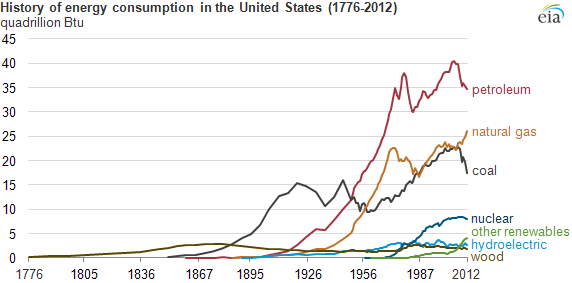
From Forests to Fossil Fuels: U.S. Energy Consumption Since 1776

What did the Founding Fathers use to power the American Revolution? Pretty much one fuel source: wood. And until the late 19th century, forests remained America’s chief energy source. Since then, it’s been mostly fossil fuels — coal, oil and natural gas — with a little bit of hydroelectric, nuclear and a smidgen of renewables like wind and solar.
That’s the takeaway from an infographic put out yesterday by the Energy Information Administration (EIA), the invaluable — and too often underappreciated — statistics arm of the Energy Department.

From Forests to Fossil Fuels: U.S. Energy Consumption Since 1776


2001-2010, A Decade of Climate Extremes - UN World Meteorological Organization Press Release

The world experienced unprecedented high-impact climateextremes during the 2001-2010 decade, which was the warmest since the start of modern measurements in 1850 and continued an extended period of pronounced global warming. More national temperature records were reported broken than in any previous decade, according to a new report by the World Meteorological Organization (WMO).
The report, The Global Climate 2001-2010, A Decade of ClimateExtremes, analysed global and regional temperatures and precipitation, as well as extreme events such as the heat waves in Europe and Russia, Hurricane Katrina in the United States of America, Tropical Cyclone Nargis in Myanmar, droughts in the Amazon Basin, Australia and East Africa and floods in Pakistan.
The decade was the warmest for both hemispheres and for both land and ocean surface temperatures. The record warmth was accompanied by a rapid decline in Arctic sea ice, and accelerating loss of net mass from the Greenland and Antarctic ice sheets and from the world’s glaciers. As a result of this widespread melting and the thermal expansion of sea water, global mean sea levels rose about 3 millimetres (mm) per year, about double the observed 20th century trend of 1.6 mm per year. Global sea level averaged over the decade was about 20 cm higher than that of 1880, according to the report.


2001-2010, A Decade of Climate Extremes - UN World Meteorological Organization Press Release


WMO Report:   The Global Climate 2001-2010

Britain Opens World's Largest Offshore Wind Farm

The world's largest offshore wind farm, which can generate enough electricity for half a million homes, was officially opened off Britain's south-east coast on Thursday.
Prime Minister David Cameron opened the 630-megawatt London Array project, which was developed by E.ON, DONG Energy, and Abu Dhabi's Masdar and produced its first electricity from all its turbines in April.

The $2.3 billion wind farm, built 20 kilometers offshore, contains 175 turbines and solidifies Britain's position at the top of the world's offshore wind league table.

Britain Opens World's Largest Offshore Wind Farm


Offshore Wind Farm

Europe Approves Emissions Trading System

The European Parliament approved on Wednesday a measure intended to revive sagging prices and confidence in the European Union’s emissions trading system, the centerpiece of Europe’s effort to cut greenhouse gases and a model for similar systems around the world.
The vote had taken on symbolic importance because Parliament had rejected a similar proposal in April. That vote threatened the carbon trading system, which has been emulated globally as a way of using markets to curb greenhouse gases.

Europe Approves Emissions Trading System


Ina Fassbender/Reuters Wind turbines and a coal power plant in Germany. Europe approved a measure aimed at raising carbon permit prices.