
Tuesday, September 17, 2019
Naomi Klein: ‘We Are Seeing the Beginnings of the Era of Climate Barbarism’

Why are you publishing this book now?
I still feel that the way that we talk about climate change is too compartmentalised, too siloed from the other crises we face. A really strong theme running through the book is the links between it and the crisis of rising white supremacy, the various forms of nationalism and the fact that so many people are being forced from their homelands, and the war that is waged on our attention spans. These are intersecting and interconnecting crises and so the solutions have to be as well.
The book collects essays from the last decade, have you changed your mind about anything?
When I look back, I don’t think I placed enough emphasis on the challenge climate change poses to the left. It’s more obvious the way the climate crisis challenges a rightwing dominant worldview, and the cult of serious centrism that never wants to do anything big, that’s always looking to split the difference. But this is also a challenge to a left worldview that is essentially only interested in redistributing the spoils of extractivism [the process of extracting natural resources from the earth] and not reckoning with the limits of endless consumption.
What’s stopping the left doing this?
In a North American context, it’s the greatest taboo of all to actually admit that there are going to be limits. You see that in the way Fox News has gone after the Green New Deal – they are coming after your hamburgers! It cuts to the heart of the American dream – every generation gets more than the last, there is always a new frontier to expand to, the whole idea of settler colonial nations like ours. When somebody comes along and says, actually, there are limits, we’ve got some tough decisions, we need to figure out how to manage what’s left, we’ve got to share equitably – it is a psychic attack. And so the response [on the left] has been to avoid, and say no, no, we’re not coming to take away your stuff, there are going to be all kinds of benefits. And there are going to be benefits: we’ll have more livable cities, we’ll have less polluted air, we’ll spend less time stuck in traffic, we can design happier, richer lives in so many ways. But we are going to have to contract on the endless, disposable consumption side.
Read more at Naomi Klein: ‘We Are Seeing the Beginnings of the Era of Climate Barbarism’
Deforestation Is Getting Worse, 5 Years After Countries and Companies Vowed to Stop It
As fires in the Amazon draw attention to the problem, critics say big agribusinesses aren't doing enough to stop deforestation in their supply chains.
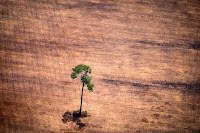 Five years after joining in a historic commitment to stop cutting the world's forests, governments and companies are not only failing to slow deforestation, they are rapidly driving the disappearance of more trees.
As fires consume Amazonian forests, stoking global concern about the loss of a vital ecosystem and climate regulator, a new report published Thursday finds that forests continue to be cleared at an alarming rate, driven mostly by agricultural expansion and demand for beef, palm oil and soy.
"We're losing the battle, so to speak, on stopping deforestation," said Craig Hanson, a vice president at the World Resources Institute. "This is a clarion call."
Read more at Deforestation Is Getting Worse, 5 Years After Countries and Companies Vowed to Stop It

As fires consume Amazonian forests, stoking global concern about the loss of a vital ecosystem and climate regulator, a new report published Thursday finds that forests continue to be cleared at an alarming rate, driven mostly by agricultural expansion and demand for beef, palm oil and soy.
"We're losing the battle, so to speak, on stopping deforestation," said Craig Hanson, a vice president at the World Resources Institute. "This is a clarion call."
Read more at Deforestation Is Getting Worse, 5 Years After Countries and Companies Vowed to Stop It
Highlights: The Net-Zero Climate Change Conference in Oxford

The conference was organised by the Environmental Change Institute at the University of Oxford, which hosted a conference on the 1.5C warming limit in 2016.
Spread across three days, the conference attracted a varied mix of around 160 science and policy researchers, energy experts, and industry representatives.
It was modeled loosely on the Talanoa Dialogue structure adopted at UN climate talks, addressing the questions “where are we?”, “where do we want to get to?” and “how do we get there?”.
Carbon Brief was at the conference to hear all the talks and ask a range of participants on camera (see below) about their priorities for achieving net-zero.
Read more at Highlights: The Net-Zero Climate Change Conference in Oxford
China Is Doing a Lot Better on Climate Action than Most People Realize

The second was that the streets were incredibly quiet, much quieter than the streets of Vancouver outside the coffee shop we were in as he told me about his trip. It wasn’t that the streets were empty. Quite the opposite. They were packed with cars and people. But virtually all the vehicles were electric. No engine noise. No diesel trucks rumbling past. No motorcycles revving. Just tire noise, which at the lower speeds typical to city streets is very quiet.
So clean air and quiet streets in the capital of China, a city of almost 22 million people. And that’s true of most other major Chinese cities as well. But a lot of people’s perspectives on China are stuck in the past, on this subject as on many others.
Right now, the US is embroiled in a trade war with China, with President Trump frequently attacking China. Infamously, he tweeted that “The concept of global warming was created by and for the Chinese in order to make US manufacturing non-competitive.” One of the key arguments many climate change deniers return to over and over again, when all of their other arguments are rapidly debunked, is that it doesn’t matter what the US does because China is the largest emitter of CO2 in the world and is still opening up coal plants.
And that’s not just a Republican or climate change denier talking point. Joe Biden’s climate change action plan spends most of its foreign policy section pointing fingers at China, from its Belt and Road Initiative to its coal subsidies.
...
But there’s another story on China, one consistent with my friend’s observations, and one that’s not being told in its entirety or understood in the west. China is likely on track to achieve its (relatively light) emissions targets a decade early. It’s bending the curve on emissions faster than any country in history, just as it ramped them up faster than any country in history.
Read more at China Is Doing a Lot Better on Climate Action than Most People Realize
Monday, September 16, 2019
Thursday, September 12, 2019
Amazon Employees Will Walk Out Over the Company’s Climate Inaction

WIRED spoke with three Amazon employees who signed the petition and plan to join the walkout. “It’s incredibly important that we show up and support the youth who are organizing this kind of thing, because I think it’s really important to show them, hey, you have allies in tech,” says Weston Fribley, a software engineer who has worked at Amazon for over four years.
“I have a chance here to influence Amazon to become a climate leader, and I think that’s the biggest impact that I personally can bring to the fight,” says Maren Costa, a principal UX designer who has worked at Amazon for over 15 years.
Read more at Amazon Employees Will Walk Out Over the Company’s Climate Inaction
Subscribe to:
Posts (Atom)