
Friday, August 24, 2018
U.S. Wind Power Is ‘Going All Out’ with Bigger Tech, Falling Prices, Reports Show
Three new government reports detail how the wind industry is expanding — offshore and onshore — and the role corporations, technology, and tax credits are playing.
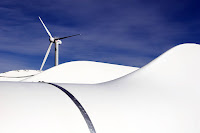 Wind power capacity has tripled across the United States in just the last decade as prices have plunged and the technology has become more muscular, the federal government's energy labs report.
Three new reports released Thursday on the state of U.S. wind power show how the industry is expanding onshore with bigger, more powerful turbines that make wind energy possible even in areas with lower wind speeds.
Offshore, the reports describe a wind industry poised for a market breakthrough.
Read more at U.S. Wind Power Is ‘Going All Out’ with Bigger Tech, Falling Prices, Reports Show

Three new reports released Thursday on the state of U.S. wind power show how the industry is expanding onshore with bigger, more powerful turbines that make wind energy possible even in areas with lower wind speeds.
Offshore, the reports describe a wind industry poised for a market breakthrough.
Read more at U.S. Wind Power Is ‘Going All Out’ with Bigger Tech, Falling Prices, Reports Show
The World’s First Electric Autonomous Container Ship To Set Sail In Norway

Though it’s not a particularly large cargo ship, 70 meters long and 14 meters wide with 120 containers on board, the difference is there won’t be any people on board, which allows for more of the space to be utilized for shipping cargo. The ship will be delivered in 2020 and plans are for it to be fully autonomous and operational by 2022. The software and engineering is to be provided by The Kongsberg Group, a major provider of military technology and autonomous control systems, and the Romanian Vard shipyard will build the freighter itself. The batteries will hold seven and a half to nine megawatt hours — the same as up to 90 batteries from the Tesla Model X P100D. Because battery technology is insufficient for long distances, the ship will only make short routes.
Read more at The World’s First Electric Autonomous Container Ship To Set Sail In Norway
Alaska’s Oil Renaissance

The North Slope region, previously considered as a mature basin, is now being touted in the media as the once and future “super-basin” thanks to an estimated 38 billion barrels of oil equivalent (BOE) in remaining recoverable resources. The report IHS Markit Plays and Basins: Alaska North Slope (ANS) Basin; Resurgence in an Arrested, Late-emerging Super Basin analysis cites that 50 trillion cubic feet (TCF) of gas, and 28 billion barrels of oil remain untapped. IHA Markit has predicted that the estimated total ultimate recovery (EUR), the sum of the remaining resources and the 16.8 billion barrels extracted up to this point, for the North Slope Basin is a staggering 54.8 billion BOE.
Read more at Alaska’s Oil Renaissance
Thursday, August 23, 2018
Kerala Shows the Risk of Severe Floods Is Still Evolving

The crisis is a timely reminder that climate change is expected to increase the frequency and magnitude of severe flooding across the world. Although no single flood can be linked directly to climate change, basic physics attests to the fact that a warmer world and atmosphere will hold more water, which will result in more intense and extreme rainfall.
The monsoon season usually brings heavy rains but this year Kerala has seen 42% more rain than would be expected, with more than 90.6in of rain across the region since the beginning of June, and over 28in in August alone.
These are similar levels seen during Hurricane Harvey, that hit Houston in August 2017, when more than 59in of rain fell during one storm. Tropical cyclones and hurricanes, such as Harvey, are expected to increase in strength by up to 10% with a 2℃ rise in global temperature. Under climate change the probability of such extreme rainfall is also predicted to grow by up to sixfold towards the end of the century. The rivers and drainage systems of Kerala have been unable to cope with such large volumes of water and this has resulted in flash flooding.
Much of that water would normally be slowed down by trees or other natural obstacles. Yet over the past 40 years Kerala has lost nearly half its forest cover, an area of 3475mi², just under the size of Greater London, while the state’s urban areas keep growing. This means that less rainfall is being intercepted, and more water is rapidly running into overflowing streams and rivers.
One of the most striking things from the videos and images emerging from the area is the brown color of the flood waters and the extreme damage caused by landslides. Our recent research has shown that geomorphology – the processes of erosion and deposition that shape the Earth’s surface – is sensitive to rainfall intensity, so more frequent and more extreme floods mean more rapid changes across our landscapes.
Read more at Kerala Shows the Risk of Severe Floods Is Still Evolving
Bigger, Stronger, Rainier: Is Hawaii’s Hurricane Lane a Sign of What’s to Come?

At the peak of its intensity late Tuesday and early Wednesday, Lane had sustained winds of 160 mph and gusts up to nearly 200 mph — making it the most powerful hurricane to threaten Hawaii on record. The storm, now downgraded from Category 5 to 4, poses a colossal threat to the islands: The National Weather Service says that “life-threatening impacts are likely.”
On Lane’s current track, Hawaii could see torrential downpours, mudslides, and 20-foot waves. The desert-like parts of the tropical islands could witness a year’s worth of rain, up to 2 feet, in mere hours. Lane should weaken as it approaches, but it could still bring tropical-storm-force winds to almost every part of every island — winds strong enough to tear roofs off homes and cause widespread power outages that could last weeks or months.
Hawaii’s governor, David Ige, declared a state of emergency in advance of the hurricane, which is expected to arrive as soon as late Wednesday night. On Twitter President Donald Trump urged those in its path to prepare. Hawaiians have taken those words to heart, clearing out grocery store shelves and filling up their gas tanks.
The vast majority of people in the state have never seen a storm like this. Since 1950, just two hurricanes have made official landfall in Hawaii, both hitting the island of Kauai. As of Wednesday afternoon, the most heavily populated islands were either under a hurricane watch or warning.
As the waters of the Central Pacific warm, hurricanes like Lane are expected to become more common — and indeed, the Pacific has seen a flurry of hurricanes near Hawaii in recent years. While the hurricane threat to Hawaii tends to peak during El Niño years, recent research shows that long-term ocean warming, not El Niño, is likely the dominant cause of Hawaii’s growing hurricane threat. And Hawaiian scientists have found these new hurricanes tend to be larger, stronger, and rainier.
A disaster response effort in Hawaii could be hindered by the Jones Act, as Puerto Rico experienced during the aftermath of Hurricane Maria. The act restricts foreign ships from delivering supplies from the mainland to the islands — meaning that Hawaiians pay inflated prices for basic supplies, which could make restocking shelves and rebuilding homes especially difficult.
Read more at Bigger, Stronger, Rainier: Is Hawaii’s Hurricane Lane a Sign of What’s to Come?
Subscribe to:
Posts (Atom)