Volkswagen Group Canada has formed Electrify Canada, a new company that will build an ultra-fast electric vehicle (EV) direct current (DC) charging network across Canada. Volkswagen expects the network to be operational starting in the second quarter of 2019.
The mission of Electrify Canada is similar to that of Electrify America, established by Volkswagen as part of the settlement over the diesel emissions cheating scandal to invest $2 billion over a ten-year period ending in 2027 in Zero Emission Vehicle (ZEV) infrastructure and education programs in the United States.
The initial Electrify Canada plan includes the installation of 32 EV charging sites near major highways and in major metro areas in British Columbia, Alberta, Ontario and Quebec. Each charging site will have four chargers on average and use the non-proprietary DC fast charging technologies (CCS and CHAdeMO).
Charging power will range from 150kW to 350kW for the expected longer range, larger battery vehicles coming to market and will also deliver 50kW charging power to support today’s EVs from all automotive manufacturers.
Read more at Volkswagen Group Canada Forms Electrify Canada to Install Network of Ultra-Fast Electric Vehicle Chargers
The steadily warming climate is driving species loss, a new study finds, with the pace of change critical to population declines.
 |
| Cheetas resting |
The warming climate is driving species loss, say British scientists who have researched how the heating of the planet and changes in land use are affecting wildlife.
Evidence abounds that the Earth’s climate is warming fast – faster than expected. At the same time, the threat of extinction is coming closer to many species. But establishing how the two are linked has so far been problematic.
Now, though, the rate at which the globe is warming has been found to be a critical factor in explaining the decline of birds and mammals, according to research by the Zoological Society of London’s Institute of Zoology published in the journal Global Change Biology.
Read more at Warming Climate Is Driving Species Loss
Homes and businesses in Texas will likely use record amounts of power again on Monday as consumers keep their air conditioners cranked up on what is expected to be the last day of a week-long heat wave, the operator of much of the state’s power grid said.
The Electric Reliability Council of Texas (ERCOT) forecast demand would reach 74,647 megawatts on Monday, which would top the current record of 73,259 MW set on July 19.
One megawatt can usually power about 1,000 U.S. homes. But on a hot day in Texas, ERCOT said one megawatt could only power about 100 homes.
Over the past week, high temperatures in Houston, the fourth-largest U.S. city, have reached 99-100 degrees Fahrenheit (37-38 Celsius) every day since July 16 and are expected to top out at 101 degrees on Monday, according to AccuWeather.
After Monday, however, power usage is expected to ease with demand on Tuesday only projected to reach 69,964 MW as temperatures return to near normal levels of around 95 degrees.
Over the past week, ERCOT said demand for power set peak records for the month on July 16 and 17 before breaking the grid’s all-time high on July 18 and 19 and the all-time weekend high on July 21 and 22.
Read more at Texas Power Use to Break Record on Monday During Heat Wave: ERCOT
From Japan to Sweden, and Oman to Texas, a global heat wave is setting records, igniting wildfires, and killing dozens all across the world this week.
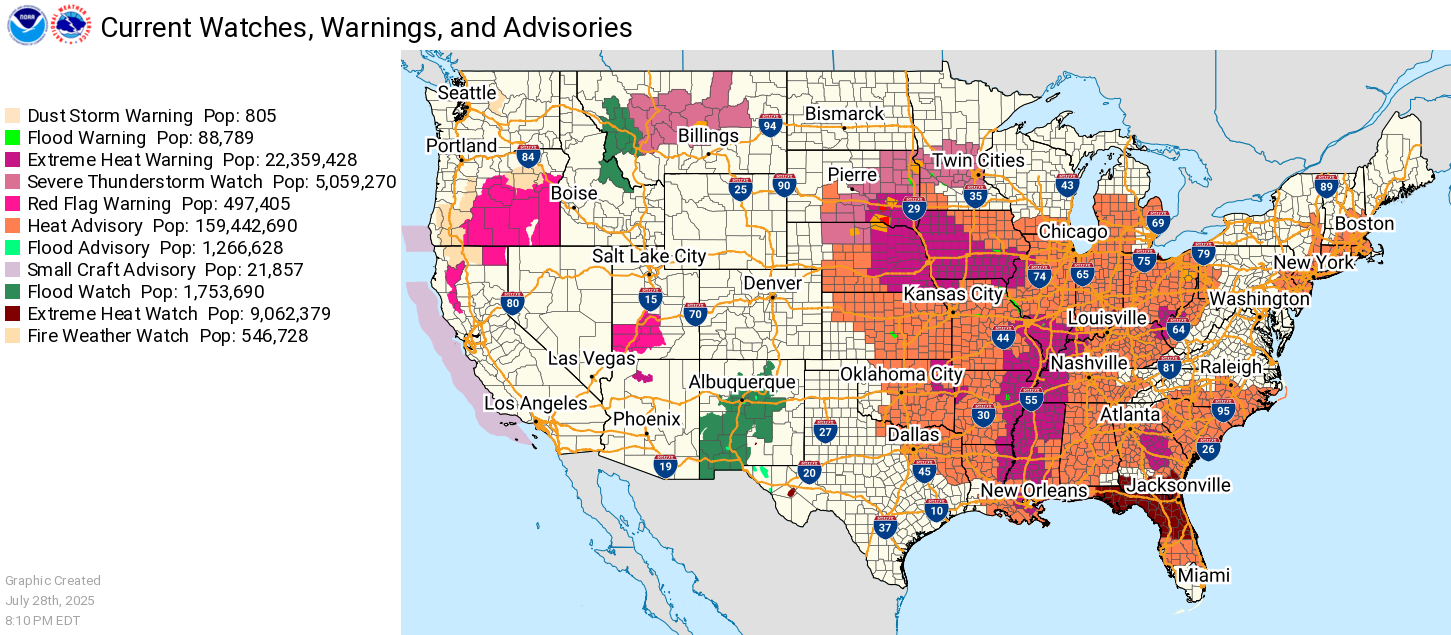
The south-central region is home to the highest temperatures in the U.S. this week, with nearly 35 million people living under excessive heat warnings issued by the National Weather Service. Temperatures are expected to be in the triple digits across Texas this weekend, marking the most severe heat wave in the state since 2011.
The Texas heat has already led to record-breaking days for the Texas power grid twice this week. Things aren’t any better elsewhere in the region, with heat indexes in Oklahoma, Arkansas, and Louisiana reaching up to 110 degrees.
...
Meanwhile, in Sweden, the Arctic Circle is on fire.
High temperatures and a prolonged drought have caused 49 fires to ignite across Sweden, with temperatures reaching 90 degrees as far north as the Arctic Circle this week. According to the Washington Post, temperatures in Scandinavia typically settle in the 60s and 70s this time of year, meaning the current heat wave is making things around 20 degrees hotter than normal.
The list of areas experiencing extreme temperatures keeps going: An Algerian city earlier this month broke the record for the highest temperature ever in Africa when it hit 124.3 degrees, and a city in Oman recorded the highest low temperature — 108.7 degrees — ever recorded on Earth. In Quebec, more than 90 people were killed by extreme heat in early July.
It’s impossible to talk about these extreme temperatures without talking about climate change. Heat domes — high-pressure areas that trap hot air and increase temperatures — are being blamed for these heat waves and they have become more common as the climate has warmed. Research has also repeatedly linked the warming climate to heat waves.
As climate scientist Ben Santer, who linked the burning of fossil fuels to the intense heat waves, told the Los Angeles Times this week, “This isn’t a big scientific surprise.”
Read more at A Global Heat Wave Has Set the Arctic Circle on Fire