Work on America’s electrical grid has slowed to a crawl, even as the power outages caused by severe weather are on the upswing. That’s the takeaway from a new report out of the President’s Council of Economic Advisers and the Department of Energy. It found that economic damage from weather-related power outages now averages between $18 and $33 billion per year — and went as high as $75 billion in 2008 and $52 billion in 2012 thanks to Hurricanes Ike and Sandy, respectively.
America’s Electric Grid Is Far Too Vulnerable to Extreme Weather, and Needs an Update
News related to climate change aggregated daily by David Landskov. Link to original article is at bottom of post.
Tuesday, August 13, 2013
‘The Era of the Lawn in the West Is Over’ as Drought-Weary Cities Urge Residents to Save Water
The southwestern U.S., an already arid region of the country, has been parched by droughts over the last few years. Now, a number of the region’s cities are cracking down on a feature of American households that the EPA says sucks up more than 15 percent of Americans’ overall water usage — the grassy lawn.
The Era of the Lawn in the West Is Over
Monday, August 12, 2013
In His Second Term, Obama Becomes Bolder on the Environment
Agency heads were given very different guideposts for the second term as Obama deputized a new team of Cabinet members to enact a series of rules and policies aimed at tackling global warming.
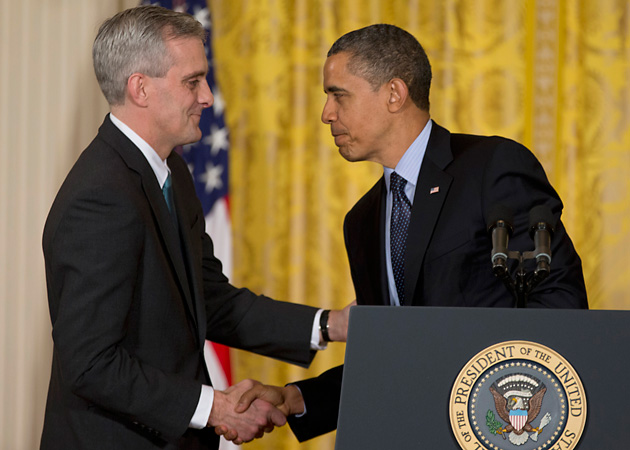
In his chief of staff, Denis McDonough, Obama has a policy manager who has written and contributed to several pieces on climate change as a senior fellow at the liberal Center for American Progress think tank in 2006 and 2007. He is a sharp contrast to former Obama chiefs of staff William Daley and Rahm Emanuel, who both privately saw global warming as a political liability for the president.
In His Second Term, Obama Becomes Bolder on the Environment - Washington Post
In his chief of staff, Denis McDonough, Obama has a policy manager who has written and contributed to several pieces on climate change as a senior fellow at the liberal Center for American Progress think tank in 2006 and 2007. He is a sharp contrast to former Obama chiefs of staff William Daley and Rahm Emanuel, who both privately saw global warming as a political liability for the president.
In His Second Term, Obama Becomes Bolder on the Environment - Washington Post
How Two Reservoirs Have Become Billboards for What Climate Change Is Doing to the American West
As soon as Monday, the federal government’s Bureau of Reclamation will announce the results of some very serious number crunching and model running focused on falling water levels in Lake Powell. It is widely expected that the bureau will announce that there is a serious water shortage and that for the first time in the 50-year-history of the dam, the amount of water that will be released from the reservoir will be cut. Not just cut, but cut by 750,000 acre feet — an acre foot being enough water to cover an acre one foot deep. That’s more than 9 percent below the 8.23 million acre feet that is supposed to be delivered downstream to Lake Mead for use in the states of California, Nevada and Arizona and the country of Mexico under the 81-year old Colorado River Compact and later agreements.
How Two Reservoirs Have Become Billboards for What Climate Change Is Doing to the American West
Sunday, August 11, 2013
Jatropha ‘Carbon Farming’ Could Lower Atmospheric CO2 Levels
Large forests planted with a single species of tough small trees could capture enough carbon from the atmosphere to slow climate change and green the world's deserts at the same time, researchers say.
A group of German scientists says the tree Jatropha curcas is resistant to arid conditions and can thrive where food crops would not survive. Since jatropha trees do require some water, the authors suggest they should be planted near coastal regions where desalinated seawater could be accessible.
Under the slogan “Nature Does it Better,” the scientists say the costs are comparable with the estimated cost of developing carbon capture and storage (CCS) technology at power stations. With only a small proportion of the world’s deserts, they say, these trees could take out most of the additional carbon dioxide emitted by humans since the beginning of the industrial revolution.
Scientists Say Nature ‘Is Better at Carbon Farming’
A group of German scientists says the tree Jatropha curcas is resistant to arid conditions and can thrive where food crops would not survive. Since jatropha trees do require some water, the authors suggest they should be planted near coastal regions where desalinated seawater could be accessible.
Under the slogan “Nature Does it Better,” the scientists say the costs are comparable with the estimated cost of developing carbon capture and storage (CCS) technology at power stations. With only a small proportion of the world’s deserts, they say, these trees could take out most of the additional carbon dioxide emitted by humans since the beginning of the industrial revolution.
Scientists Say Nature ‘Is Better at Carbon Farming’
Subscribe to:
Posts (Atom)